


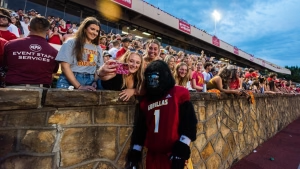
Driving through the Pittsburg, Kansas area, it is impossible to miss all of the gorillas in the area. There are thousands of gorilla statues in yards and in front of businesses. Resturaunts have menu items named after “gorillas.” And multiple gorilla sculptures are scattered across the campus of Pittsburg State University.
It is a question we get all the time: What is up with all the gorillas?
Nearly every Pittsburg State alumni has a gorilla in their yard and on their office wall or on their desk. There is great pride in being the only college in the nation with a gorilla as its mascot.
It has become a phenomenon that has outgrown the university. But it started because of a student pep club in 1920.
How the Gorillas got their name
Unique to Pittsburg State, the gorilla mascot dates to 1920. At the time “gorilla” was slang for “roughnecks” and “rowdy.” Disapointed in the amount of college spirit at the school at the time, a group of 24 students used the nickname and founded a pep club to generate enthusiasm.
Their first public appearance was at an all school assembly on Thursday, October 7, 1920. Their motto: “We want pep and we want it at all times”.
“According to Mathew’s ‘Dictionary of Americanisms,’ to call someone a gorilla in 1920 meant they possessed characteristics of strength, intimidation, and untamed rowdiness. That’s exactly the characteristics the first Pittsburg gorillas hoped to portray.”
Former PSU archivist Randy Roberts
By 1924 the pep club had grown to around 200 members.
On January 15, 1925, the gorilla was officially adopted as the school’s mascot.
The PSU mascot has come to symbolize the campus and the surrounding community as a fun place to learn and grow, with pride, poise, and perseverance.
Today, there are thousands of gorilla statues and other tributes to this endangered species just throughout Southeast Kansas. There are thousands more across the world thanks to the alumni that carry the Gorillas close to their hearts after they graduate from Pittsburg State University.
The largest monument is the Champions Plaza Gorilla (pictured above). This bronze sculpture is just outside of Carnie Smith Stadium, on the eastern side, on the campus of Pittsburg State University.
Gus the Gorilla and a real gorilla named Gus
Around 1923, art student Helen Waskey was recruited by the original pep club to make the first drawing of “Gus Gorilla”.
“Gus” has taken many forms in the generations since, and in recent decades the Gorillas have repeatedly been named among one of the most beloved mascots at any level.
The love for the Gorilla mascot is best exemplified by an online contest in 2015 to name a newborn gorilla in a Texas zoo.
When the Fort Worth Zoo announced a poll to name a Western lowland gorilla born there on December 5, 2015, one of the names up for vote was “Augustus“. Less than 24 hours after learning about the contest, Pittsburg State alumni and students, and the rest of the community helped the name to easily win.
You can support the care of Gus through the Fort Worth Zoo adoption program. You can also support their World of Primates exhibit, which is the first exhibit guests experience when they enter the zoo.
Important Dates
- October 7, 1920 – Gorillas pep club first appearance
- January 15, 1925 – The Gorilla adopted as the official mascot of the school
- December 5, 2015 – Baby gorilla eventually named Augustus (“Gus”) born in Fort Worth Zoo.
- Every June 17 – National Mascot Day
- Every September 24 since 2017 – World Gorilla Day


